Start building a culture of growth today.
Join the hundreds of organisations embedding mentoring and empowering their teams with the Art of Mentoring.


19 March, 2020 | 4 mins read
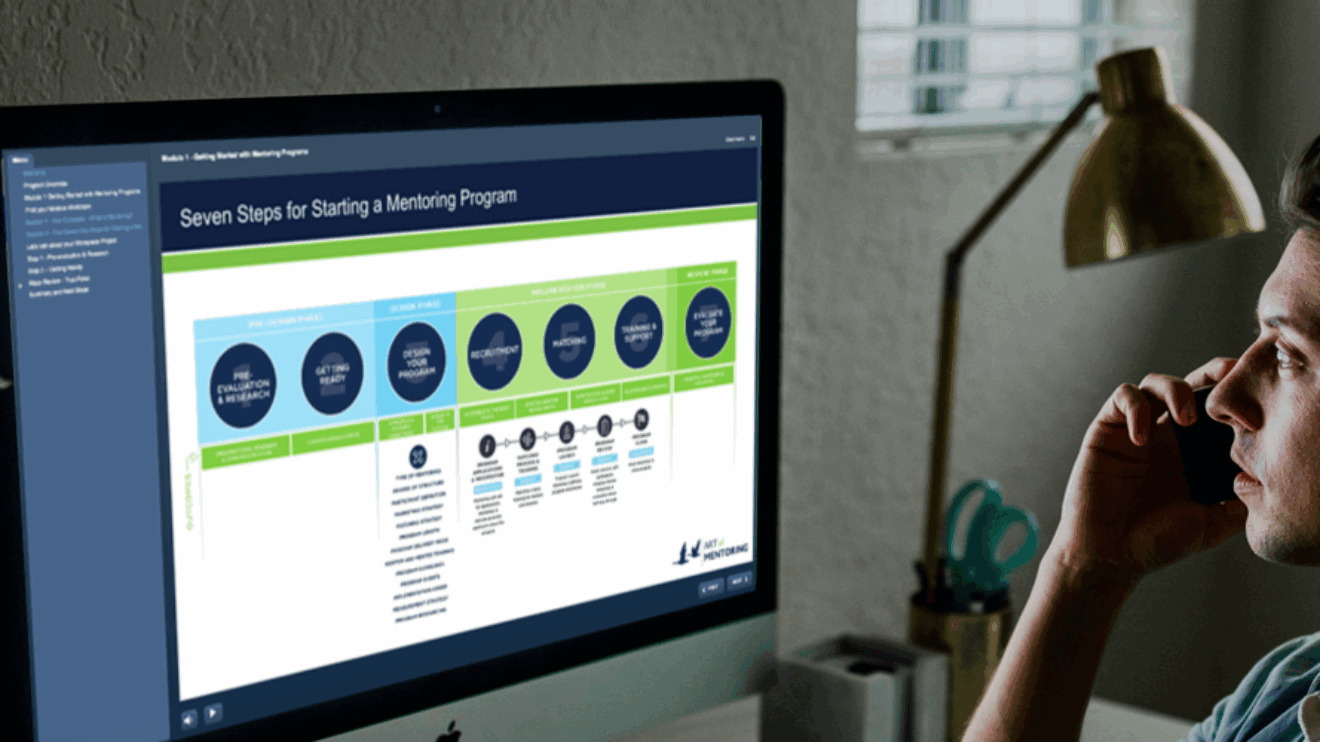
A best-practice guide to virtual mentoring
Art of Mentoring is a 100% virtual organisation – our employees are spread along the Australian east coast from Brisbane to Devonport, and for us, working from different locations and collaborating virtually is business-as-usual. Our clients are spread all around the world, with programs spanning Australia, New Zealand, Asia, Europe and the UK.
Virtual mentoring, or distance mentoring, can be surprisingly effective, even though it is not necessarily everyone’s first choice. Our Managing Director, Melissa, has written before about the art of virtual mentoring – the pros and cons of electronic communication, and the need for program managers to design a mentoring program with these in mind.
But how does virtual mentoring feel for participants? What are the advantages and disadvantages for individuals, and how do we grasp this new virtual world with both hands?
I recently had the pleasure of interviewing the Art of Mentoring 2019 Mentor of the Year, Tim, and his Mentee, Lou, and found that their virtual mentoring method was key to the success of their work together.
Now I have to say up front that Tim and Lou were lucky enough to meet face-to-face, just once, at the beginning of their relationship, when a family holiday brought Tim to within an hour’s drive of Lou’s home town. Having a friendly coffee together certainly got them off to a good start, but it’s what they did next that made it extraordinary.
In their first couple of communications, Tim and Lou talked openly about the challenges that a long-distance relationship might pose, and they decided they’d meet on Skype using webcams – as awkward as it seemed it might be, they found it wasn’t too hard to let their guard down a little and work through the awkward initial phase together.
But after a couple of meetings, something still wasn’t right. They weren’t getting to the nub of the issues during their conversations, spending much of their time trying to understand where each other was coming from but rarely moving forward to new understandings, and they were getting to the end of 90 minutes with topics left to discuss. They decided to implement a preparation process – the Mentee would send an email about a week in advance with 4 or 5 topics or questions for discussion as well as a little background to her current view or dilemma. The Mentor took a couple of days to think through his answer, and sent a reply email for her to contemplate for a couple of days before their scheduled call.
When they started their facetime call, they already had their teeth firmly in the conversation! They had an understanding of each other’s position, and had articulated their own, and had the chance to think about where the conversation might go and what questions they might ask the other.
Why did this work so well?
Because they had an early, open and constructive conversation about how they would work together, this team entered their first skype call with a positive and collaborative mindset.
Because they “took stock” after a few meetings, they identified a need to try something different, and went into problem-solving to come up with a new way of working together.
Their new solution took advantage of the benefits of both email (time and space to think and formulate a response, freedom to read and respond when best suited them, avoiding distraction and apparent differences) and face-to-face conversations (non-verbal cues, spontaneous and interactive). Their separation in distance and time – when it suited them – became an opportunity rather than a hindrance, and was easily forgotten when they connected in cyberspace!
Here are some simple pointers on how to make a virtual mentoring connection powerful, many of which were employed by Tim and Lou:
With these thoughts in mind, and a collaborative problem-solving approach, every mentoring partnership can find its own way of working that defies our preconceptions about virtual connection. Successful mentoring partners put as much effort into creating and nurturing the relationship as they do addressing the mentoring content, and what better skillset to master in the new virtual world?
© Gina Meibusch 2020
Download our introductory guide ‘The Ripple Effect’ to mentoring and learn the secrets to unleashing hidden value in your organisation
Compiled by our mentoring experts, this guide will introduce you to the secrets of unleashing hidden value in your organisation.
Art of Mentoring CRM needs the contact information you provide to us to contact you about our products and services. You may unsubscribe from these communications at any time. For information on how to unsubscribe, as well as our privacy practices and commitment to protecting your privacy, please review our Privacy Policy.
"*" indicates required fields
Join the hundreds of organisations embedding mentoring and empowering their teams with the Art of Mentoring.

By subscribing, you agree to Art of Mentoring contacting you about our products and services. You may unsubscribe from this communicaiton at any time using the ‘unsubscribe’ link at the bottom of our emails. The Privacy Policy, located on our website outlines our commitment to protecting your privacy.
"*" indicates required fields