Start building a culture of growth today.
Join the hundreds of organisations embedding mentoring and empowering their teams with the Art of Mentoring.


20 November, 2019 | 5 mins read

Organisations spend a great deal of money on turnover-related expenses each year. Many also invest heavily in engagement surveys, in an effort to predict where they’re vulnerable to low productivity and loss of key talent. Engagement has been found to contribute to a raft of benefits including: Higher productivity, achievement of work goals, reduced turnover and accidents, higher customer satisfaction and higher profitability.[1]
But what exactly is engagement, what is the result of high engagement, what drives it, and what role can mentoring play in that?
In published articles and research, I found many definitions for engagement, but no universally accepted definition (as with most HR concepts). It can be described as a performance concept, an attitude or a psychological state. A common theme seems to be that engagement is defined “to some degree by its outcomes and something given by the employee which can benefit the organisation”[2].
Schaufeli et al[3] characterised engagement by:
The British Institute for Employment Studies (IES) distinguishes between engagement with the job and engagement with the organisation, as it’s possible to have one without the other.
In their model, job engagement is highly associated with enhanced:
High organisational engagement is linked to “organisational citizenship behaviours” which are positively related to the success of the organisation.[4]
Another similar model of engagement was conceptualised by Aon Hewitt. This model focuses on the degree to which employees:
Let’s move on to the link between mentoring and engagement. Mentored individuals have been found to have higher engagement than those who are not mentored,[6] but how does it work?
IES offers a nice visual model of job engagement, organisational engagement, their drivers and outcomes.
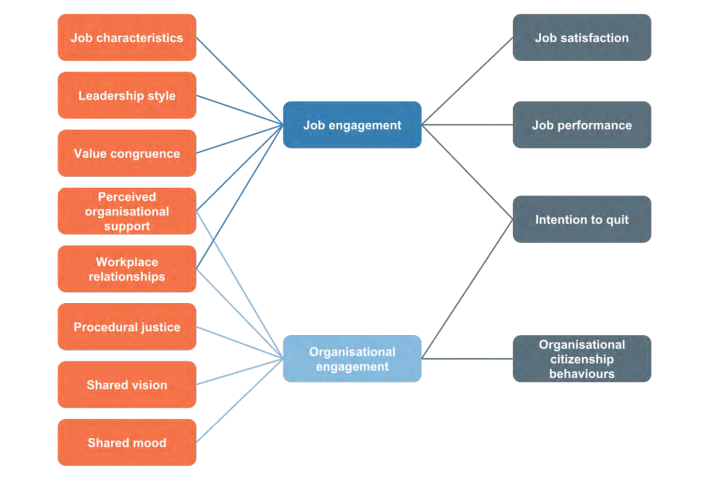
I’ll use this model to explain where and how mentoring can add value within five of these drivers and help deliver higher job and organisational engagement.
Most workplace mentoring is performed by people other than the line manager, who usually has the greatest influence over designing jobs to maximise engagement. However, we see time and time again in our mentoring programs, that an employee, with the help of a mentor, can be empowered to have fruitful conversations about how to enrich his/her own role. Mentoring is highly related to job/ role satisfaction for both mentors and mentees.
Transformational leadership has been demonstrated to play a role in employee engagement. This style of leadership guides followers through inspiration and motivation, by taking an interest in their needs, encouraging them and supporting them to try new approaches. This could just as well be describing good developmental mentoring! In fact, there is increasing evidence that leadership and mentoring are overlapping concepts. The microskills of good mentoring – active listening, asking questions, guiding, challenging – are the skills that good leaders need. Mentors learn these skills in training provided as part of well-managed mentoring programs and can then practise them with their mentees. So, participating as mentors in structured programs is in fact a leadership development activity.
Whilst never a replacement for having a competent manager, a great mentor can act as a role model for the kind of leadership that many employees desire to receive, but often don’t. By enrolling its best leaders as mentors in a mentoring program, an organisation can disseminate good leadership throughout the organisation.
A team member whose personal values line up with those of the organisation, is more willing to be fully engaged.[7] But too often, employees aren’t aware of the values their employer wishes to embed because they’re not explicitly communicated and leaders don’t necessarily walk the talk. Organisations can use mentoring as a socialisation opportunity to communicate a consistent set of values in line with the organisation’s vision and mission, and appoint good role models as mentors.
This means when employees believe that their contribution and wellbeing is important to their employer. In the mentoring programs we run, we include questions about the impact the mentoring experience has had on mentors and mentees, in a variety of ways, including on their feelings about the organisation. Highly positive impacts are routinely observed amongst both groups. People in mentoring relationships scored highly in a recent study, on company perception, development opportunities, and work environment — they felt their organisation is a better place to work and they were more positive about the senior leaders, than their non-mentored peers.[8]
Our own surveys show employees want their organisation to provide them with development opportunities. Mentoring helps people to identify their strengths and development needs[9] and pursue career goals.
People focus a lot on the employee-manager relationship. But broader workplace relationships also contribute to organisational engagement. In mentoring programs, a mentee develops a strong, trusting relationship with another person who is usually not their direct manager. Mentees also develop relationships with other members of the program cohort, with whom they share the experience. They often access their mentors’ networks to extend their contacts more broadly across the organisation. Mentors too, connect with other mentors and mentees in their program cohort.
If your organisation suffers from engagement issues, especially at lower levels (senior leaders are usually more highly engaged), then the introduction of a well-designed and managed mentoring program is a low cost, high impact intervention.
[1] Madan, Poornima and Srivastava, Shalini (2016). Investigating the role of mentoring in managerial effectiveness-employee engagement relationship: an empirical study of Indian private sector bank managers. European Journal of Cross-Cultural Competence and Management, Vol. 4, No. 2.
[2] Sange, Rbiya and Srivasatava, R.K. (2012) Employee Engagement and Mentoring: An Empirical Study of Sales Professionals, Synergy, Vol. X No. I, p. 38
[3] Schaufeli, W., Salanova, M., Gonzalez-Roma, V. and Bakker, A. (2002). ‘The measurement of
burnout and engagement: a confirmatory factor analytic approach’, Journal of Happiness
Studies, Vol. 3, pp.71–92.
[4] Edwards, Megan (2018). Bridging the gap: an evidence-based approach to employee engagement. IES Member Paper, downloaded from https://www.employment-studies.co.uk/system/files/resources/files/mp141_Bridging_the_gap_evidence-based_approach_to_employee_engagement_0.pdf
[5] Aon Hewitt (2015) Trends in Global Employee Engagement, downloaded from https://www.sigmoidcurve.com/assets/Uploads/2015-trends-in-global-employee-engagement-sigmoid-connect.pdf
[6] Sange & Srivasatave, op cit
[7] Rich B L, Lepine J A, Crawford E R (2010), ‘Job Engagement: antecedents and effects on job performance’, Academy of Management Journal, Vol. 53, No. 3
[8] Sange & Srivasatava, op cit
[9] Sange & Srivasatava, ibid.
© Melissa Richardson, 2019
Download our introductory guide ‘The Ripple Effect’ to mentoring and learn the secrets to unleashing hidden value in your organisation
Compiled by our mentoring experts, this guide will introduce you to the secrets of unleashing hidden value in your organisation.
Art of Mentoring CRM needs the contact information you provide to us to contact you about our products and services. You may unsubscribe from these communications at any time. For information on how to unsubscribe, as well as our privacy practices and commitment to protecting your privacy, please review our Privacy Policy.
"*" indicates required fields
Join the hundreds of organisations embedding mentoring and empowering their teams with the Art of Mentoring.

By subscribing, you agree to Art of Mentoring contacting you about our products and services. You may unsubscribe from this communicaiton at any time using the ‘unsubscribe’ link at the bottom of our emails. The Privacy Policy, located on our website outlines our commitment to protecting your privacy.
"*" indicates required fields