Start building a culture of growth today.
Join the hundreds of organisations embedding mentoring and empowering their teams with the Art of Mentoring.


23 April, 2024 | 4 mins read

There was a time when a pay rise was the simplest answer to a retention problem. That time has largely passed.
65% of workers now regard upskilling and professional development as vital to their employment decisions. Across every generation in today’s workforce, meaningful growth opportunities are outranking salary as a driver of loyalty, engagement and job satisfaction. The organisations that understand this are pulling ahead in the talent market. The ones that do not are watching their best people leave for employers who do.
In this article we look at what today’s workforce actually values, why mentoring delivers something a pay rise cannot, and how to design a mentoring strategy that genuinely moves the retention needle.
The pandemic accelerated a shift that was already underway. People started asking different questions about work, not just what will I earn but what will I become here.
LinkedIn’s research found that 94% of employees would stay longer at a company that actively invested in their career development. That is not a marginal preference. It is a decisive factor in whether your best people stay or start looking.
Across generations, the signal is consistent. Younger workers entering the workforce rank development and mentoring among their top priorities when choosing an employer. Mid-career professionals who feel their growth has plateaued are far more likely to be looking. And senior professionals who no longer feel stretched or valued leave quietly and expensively.
Salary matters. But for most employees, it is table stakes. Once someone feels adequately paid, the decision to stay or go is almost never about money.
A pay rise improves take-home income. Mentoring improves confidence, capability, clarity and connection, which are the things that make a career feel worth staying for.
Mentoring provides personalised guidance from someone who has navigated similar terrain. A safe space to explore uncertainty and test ideas. Access to networks and opportunities that would otherwise stay closed. And the kind of recognition that says: we see your potential and we are investing in it.
Those things cannot be replicated by a pay increase. A mentor who helps someone think through a difficult career decision, identify a blind spot or open a door to a new opportunity is delivering something with lasting value. The employee remembers it. They tell people about it. It becomes part of why they stay.
For mentors, the benefits are equally real. Re-engagement with purpose, development of leadership skills and the satisfaction of genuinely shaping someone else’s growth. Mentors in well-run programs consistently report that the experience is one of the most rewarding things they have done in their professional careers.
Sun Microsystems tracked retention across mentored and non-mentored employee cohorts over several years. The results are hard to ignore. Mentoring saved 6.7 million dollars in avoided turnover costs. Mentored employees were five times more likely to be promoted than their unmentored peers.
In Fortune 500 research, the five most commonly reported outcomes of formal mentoring programs are retention, promotion rates, employee satisfaction, morale and productivity. These are not soft metrics. They are the variables that drive business performance.
Plug in your own organisation’s annual cost of turnover and the ROI becomes immediately clear. For a mid-sized organisation losing 15 employees per year at an average replacement cost of 30,000 dollars each, a mentoring program that improves retention by even 20% saves 90,000 dollars annually. That is a return many times the cost of a well-run program.
Mentoring has its highest retention impact on three groups.
Early career employees, typically those in their first five years of work, are the most mobile segment of any workforce and often the most expensive to replace when you factor in the cost of lost potential. They are also the group most likely to stay if they feel genuinely invested in. A mentoring program that pairs early career employees with experienced professionals signals that the organisation sees a future for them.
High-potential employees who are not yet in senior roles are equally at risk. They are often the people most likely to be headhunted, and the least likely to raise concerns internally before they leave. Mentoring gives them a channel for honest conversation and a visible sign that their development is taken seriously.
Women and employees from underrepresented groups are disproportionately likely to leave organisations where they do not see a path to advancement. Targeted mentoring programs that address access to networks, visibility and sponsorship are one of the most effective tools for changing this.
The most effective mentoring programs do not just serve the individual. They connect personal development to the organisation’s strategic direction. When employees can see a clear line between their own growth and what the business is trying to achieve, engagement and performance rise together.
That is what strategic mentoring looks like in practice. It is the difference between a program that gets results, retains people and builds a leadership pipeline, and one that quietly fades after the first cohort because nobody could articulate what it was for.
At Art of Mentoring, we work with organisations to design programs that are explicitly tied to business goals. Whether the priority is retaining early career talent, developing the next layer of leadership, or building a more inclusive culture, we design and measure accordingly. The result is a mentoring program you can justify, not just celebrate.
Download our introductory guide ‘The Ripple Effect’ to mentoring and learn the secrets to unleashing hidden value in your organisation
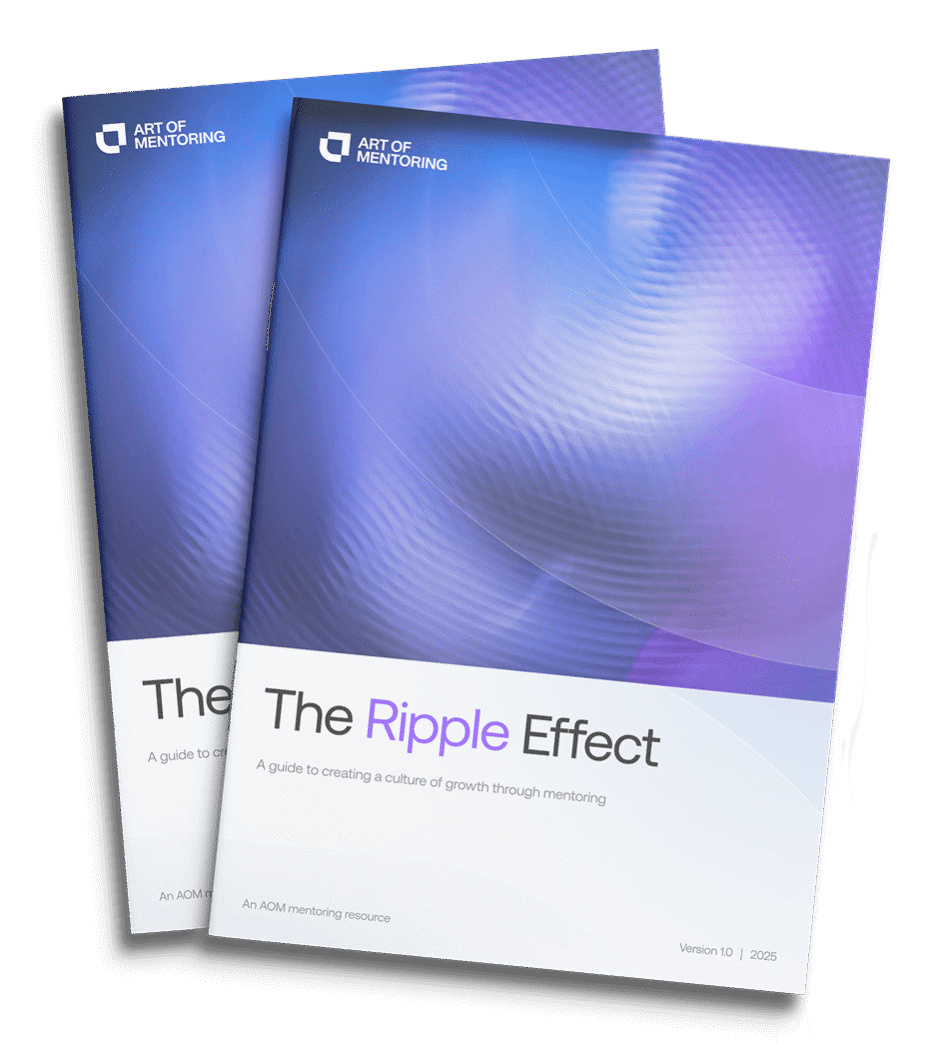
Compiled by our mentoring experts, this guide will introduce you to the secrets of unleashing hidden value in your organisation.
Art of Mentoring CRM needs the contact information you provide to us to contact you about our products and services. You may unsubscribe from these communications at any time. For information on how to unsubscribe, as well as our privacy practices and commitment to protecting your privacy, please review our Privacy Policy.
"*" indicates required fields
Join the hundreds of organisations embedding mentoring and empowering their teams with the Art of Mentoring.

By subscribing, you agree to Art of Mentoring contacting you about our products and services. You may unsubscribe from this communicaiton at any time using the ‘unsubscribe’ link at the bottom of our emails. The Privacy Policy, located on our website outlines our commitment to protecting your privacy.
"*" indicates required fields