Start building a culture of growth today.
Join the hundreds of organisations embedding mentoring and empowering their teams with the Art of Mentoring.


22 January, 2025 | 3 mins read

Every people program eventually faces the same question: is this worth the investment? Mentoring is no exception. The good news is that when you measure it properly, the case is genuinely compelling.
Organisations that track their mentoring programs consistently find significant returns across retention, engagement, leadership development and culture. The challenge is not the lack of evidence. It is knowing what to measure and how to present it to the people whose sign-off you need.
This article walks through the metrics that matter, how to build a business case that holds up under scrutiny, and the common mistakes organisations make when they try to prove the value of their programs.
Quantifying the impact of mentoring allows organisations to secure ongoing funding and executive support, demonstrate alignment with business objectives, showcase value to members and identify where programs can be improved.
Without measurement, even the best programs are vulnerable at budget time. With clear data, they become a strategic priority that is hard to cut. The organisations that lose their mentoring budgets are usually the ones that never built the measurement habit in the first place.
The most cited study on mentoring ROI comes from Sun Microsystems, which tracked retention across mentored and non-mentored employee cohorts over time. The findings were striking. Mentoring saved 6.7 million dollars in avoided turnover costs. Mentored employees were five times more likely to be promoted than their unmentored peers. The estimated ROI exceeded 1,000%.
That figure gets quoted often, but the underlying logic is straightforward and applies to any organisation. Take your annual cost of losing and replacing an employee, typically estimated at one to two times their annual salary when you factor in recruitment, onboarding and productivity loss. Then apply the retention improvement that mentoring typically delivers, and the numbers add up quickly.
For a team of 100 people with average salaries of 80,000 dollars and a 15% annual turnover rate, even a 3% improvement in retention through mentoring can represent hundreds of thousands of dollars in avoided costs per year.
Retention is the most straightforward starting point. Compare retention rates between program participants and non-participants over twelve months. If your mentored employees are staying at higher rates, you have a clear financial story to tell.
Engagement scores, promotion rates and internal mobility data give you a fuller picture. Mentored employees typically show higher engagement and move into new roles faster, both of which matter for your workforce planning.
Satisfaction data is equally important. Art of Mentoring’s 2020 research across 13,000 participants found that 85% of mentees and 80% of mentors said their experience improved their impression of the organisation that offered the program. That kind of employer brand signal is hard to put a dollar figure on but very easy to communicate to senior leaders.
For diversity-focused programs, track representation of underrepresented groups in leadership roles before and after sustained investment. That is where the cultural shift becomes visible and the long-term case for continued investment becomes undeniable.
The most persuasive business cases combine numbers with stories. Quantitative evidence gives stakeholders the financial anchor they need. Participant stories make the impact real and human.
Start with retention. Pull your organisation’s actual cost of turnover and calculate what even a modest retention improvement is worth in dollar terms. That framing immediately puts mentoring in commercial rather than HR terms.
Then layer in the broader metrics: engagement, promotion rates, satisfaction scores. Compare your program participants against non-participants, and where possible, against industry benchmarks.
Finally, include participant voices. A short quote from a mentee describing what the program meant for their confidence, their network or their career clarity is often the most persuasive element of any mentoring report. Numbers get people to the meeting. Stories get them to yes.
Measuring only at the end of the program is the single biggest mistake. By the time a program closes, the data that would have been most useful for improvement is gone. Build measurement into every phase: at launch, at the midpoint, at close and, where possible, six months after the program ends.
Relying on satisfaction scores alone is another trap. Participants often rate a mentoring program highly even when their stated goals were not achieved. Satisfaction tells you whether people enjoyed the experience. Outcome data tells you whether it worked.
Finally, failing to set goals before the program begins makes retrospective measurement almost impossible. The most effective programs define what success looks like at the design stage, before the first application arrives.
We do not just design and deliver programs. We help organisations measure them properly from start to finish. Our evaluation framework, adapted from Roger Kaufman’s Five Levels of Evaluation, tracks impact from program inputs through to organisational and societal outcomes.
We work with clients including the NSW Department of Primary Industries to follow mentee outcomes over multiple years after program completion, comparing career progression and retention against unmentored peers. That kind of longitudinal accountability is what secures ongoing investment and makes the case for expanding programs over time.
If you are looking to build a stronger measurement approach for your existing program, or want to set one up properly from the start, we would be glad to help.
Download our introductory guide ‘The Ripple Effect’ to mentoring and learn the secrets to unleashing hidden value in your organisation
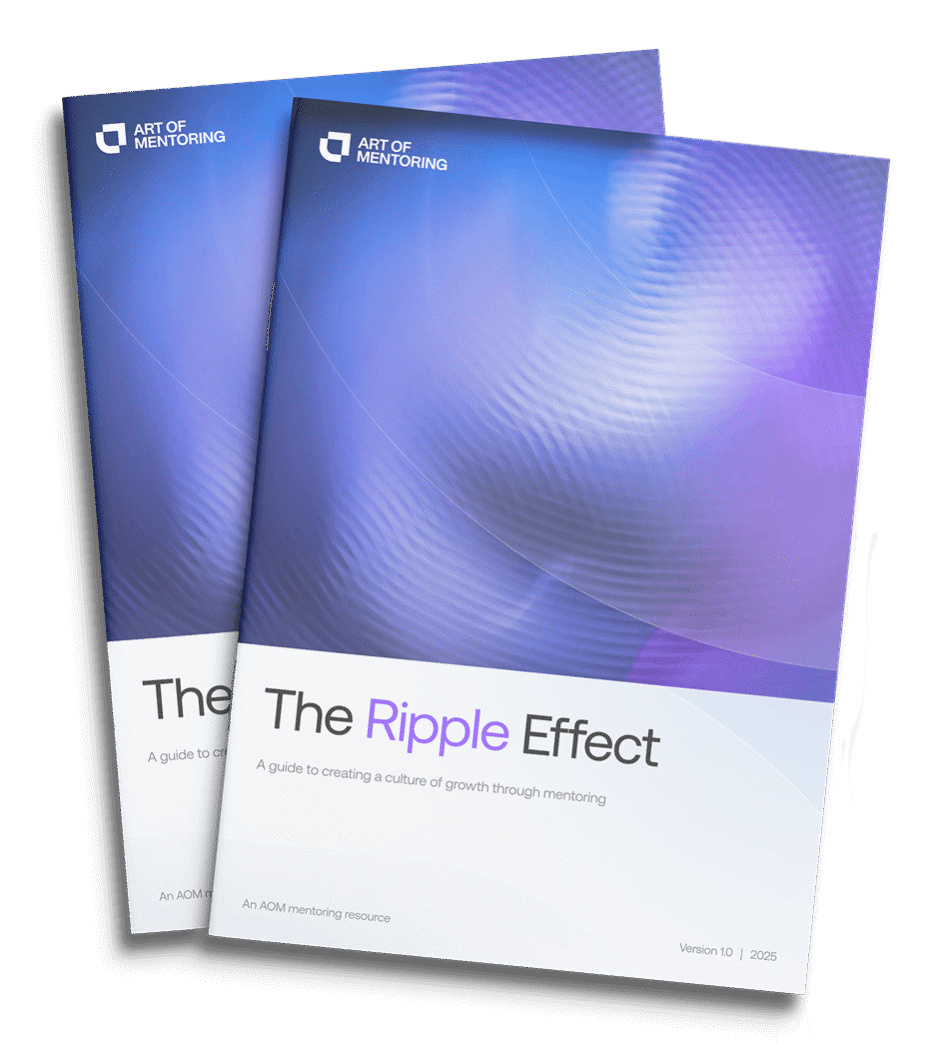
Compiled by our mentoring experts, this guide will introduce you to the secrets of unleashing hidden value in your organisation.
Art of Mentoring CRM needs the contact information you provide to us to contact you about our products and services. You may unsubscribe from these communications at any time. For information on how to unsubscribe, as well as our privacy practices and commitment to protecting your privacy, please review our Privacy Policy.
"*" indicates required fields
Join the hundreds of organisations embedding mentoring and empowering their teams with the Art of Mentoring.

By subscribing, you agree to Art of Mentoring contacting you about our products and services. You may unsubscribe from this communicaiton at any time using the ‘unsubscribe’ link at the bottom of our emails. The Privacy Policy, located on our website outlines our commitment to protecting your privacy.
"*" indicates required fields