Start building a culture of growth today.
Join the hundreds of organisations embedding mentoring and empowering their teams with the Art of Mentoring.


10 April, 2022 | 3 mins read

In a competitive talent market, the organisations winning are not necessarily paying the most. They are offering something more lasting: a genuine investment in their people’s growth.
Strategic mentoring, designed with clear objectives, aligned to business goals and measured rigorously, is one of the highest-leverage tools available for achieving this. Organisations that treat it as a core strategy consistently outperform those that treat it as a nice-to-have.
But what does strategic mentoring actually mean in practice, and how do you know if what you are running qualifies? This article breaks it down.
Many organisations run mentoring programs. Fewer run strategic mentoring.
A mentoring program pairs people up and hopes for the best. Strategic mentoring starts with a business problem and works backwards. What is the organisation trying to achieve in the next three years? Where are the talent gaps, the retention risks, the leadership pipeline vulnerabilities? Which specific cohorts need support, and what kind of support will actually move the needle?
Strategic mentoring answers those questions before the first pair is matched. The program design, the matching criteria, the training, the measurement framework, all of it is built around delivering on defined outcomes. That is the difference between a program you can measure and defend at budget time, and one that exists because it feels like the right thing to do.
Art of Mentoring’s research and program data show that mentoring contributes across all six pillars of the employee value proposition.
It builds capability in both mentors and mentees. It has a documented psychosocial benefit, providing emotional support and normalising workplace challenges. It breaks down silos in cohort-based programs. It reconnects people with meaning in their work. And it builds trust in the organisation.
46% of mentees in Art of Mentoring’s 2020 research said the program was one of the best things they had done in their career. 85% said it improved their impression of the organisation that offered it.
That last figure is worth pausing on. A mentoring program is not just a development tool. It is a signal. It tells employees, and potential employees, that this organisation takes the development of its people seriously. In a market where employer brand is a real competitive advantage, that signal matters.
Sun Microsystems tracked retention across mentored and non-mentored cohorts over several years. The headline numbers are well known in HR circles but worth repeating. Mentoring saved 6.7 million dollars in avoided turnover costs. Mentored employees were promoted five times more often than their peers. The estimated ROI exceeded 1,000%.
Apply those proportions to your own organisation’s annual cost of turnover and the business case is immediate. For most mid-to-large organisations, a well-designed mentoring program pays for itself many times over within the first two years, before you even count the less tangible benefits of improved engagement, stronger culture and a more capable leadership pipeline.
Strategic mentoring means connecting program objectives explicitly to business goals. Not vaguely, not aspirationally, but specifically. If the goal is retention, define the retention rate you are targeting and set up the measurement to track it. If the goal is leadership pipeline development, define the competencies you are building and measure them at entry and exit.
It means measuring outcomes at every level: participant satisfaction, learning and skill development, application of that learning in the workplace, and organisational outcomes like retention, engagement and promotion rates.
It means offering multiple program types where appropriate. Targeted cohort programs for specific groups, a graduate intake, women in leadership, new managers, sit alongside broader informal mentoring options for wider cultural impact. One size does not fit all.
And it means using technology to automate the administrative load so that program managers can focus on relationships and outcomes rather than logistics.
How many programs does a strategic mentoring approach require? There is no single answer, but most mature mentoring strategies include at least two or three program types targeting different cohorts and business objectives. Some organisations run five or more.
Does strategic mentoring require dedicated resources? Yes, but less than most people assume. The right technology platform handles a significant portion of the administrative work. A part-time program coordinator can run a 50 to 100 pair program effectively with the right tools and support in place.
How long does it take to see results? Retention improvements typically show up within 12 months. Engagement and satisfaction data can be captured at program close, around six months in. Leadership pipeline impacts take longer, typically 18 to 36 months, but they are the most commercially significant.
We work with organisations to design, implement and measure strategic mentoring programs at scale. Whether you are building your first formal program or evolving an existing one into something more deliberate and measurable, we bring the evidence base, the technology and the operational expertise to make it work.
Our clients range from government departments and professional associations to corporate and not-for-profit organisations. What they have in common is a commitment to doing mentoring properly, not just ticking the box. If that resonates, we would be glad to have a conversation about what strategic mentoring could look like for your organisation.
Download our introductory guide ‘The Ripple Effect’ to mentoring and learn the secrets to unleashing hidden value in your organisation
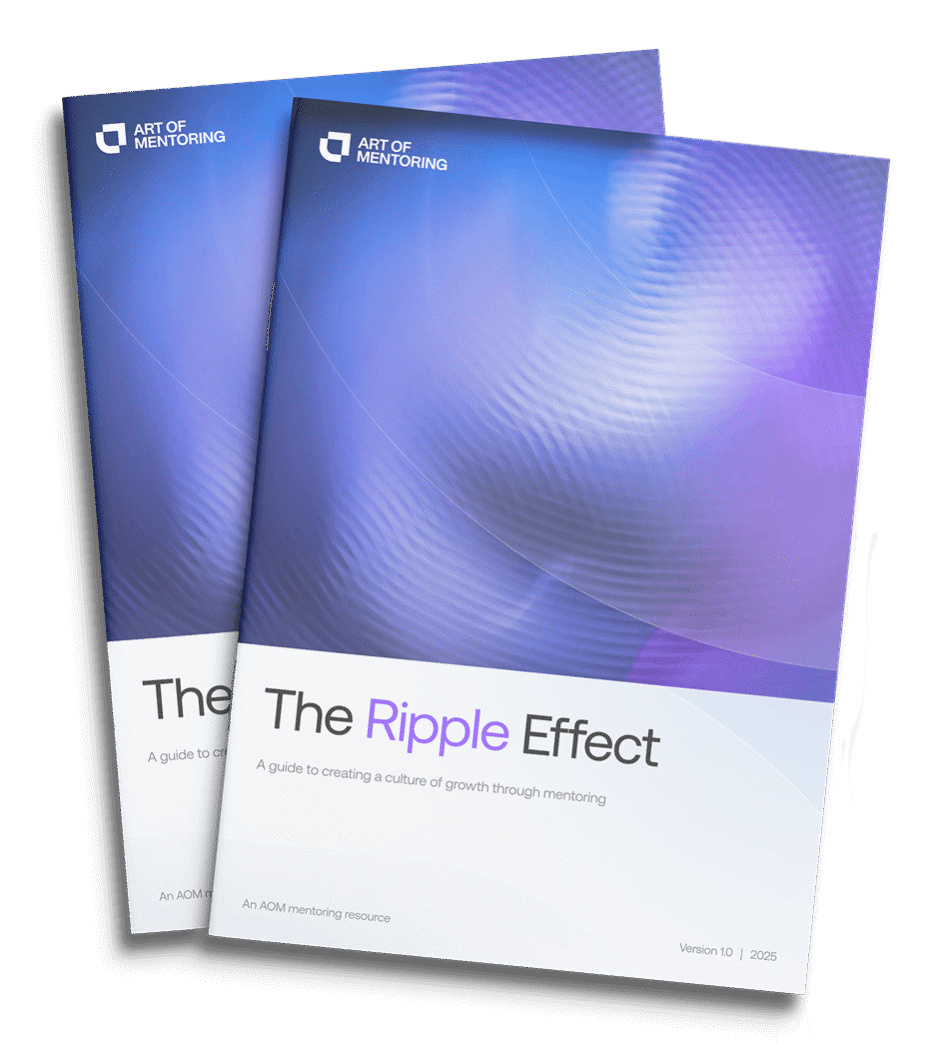
Compiled by our mentoring experts, this guide will introduce you to the secrets of unleashing hidden value in your organisation.
Art of Mentoring CRM needs the contact information you provide to us to contact you about our products and services. You may unsubscribe from these communications at any time. For information on how to unsubscribe, as well as our privacy practices and commitment to protecting your privacy, please review our Privacy Policy.
"*" indicates required fields
Join the hundreds of organisations embedding mentoring and empowering their teams with the Art of Mentoring.

By subscribing, you agree to Art of Mentoring contacting you about our products and services. You may unsubscribe from this communicaiton at any time using the ‘unsubscribe’ link at the bottom of our emails. The Privacy Policy, located on our website outlines our commitment to protecting your privacy.
"*" indicates required fields